
Market Update 2026
by Sunburst Investment Committee
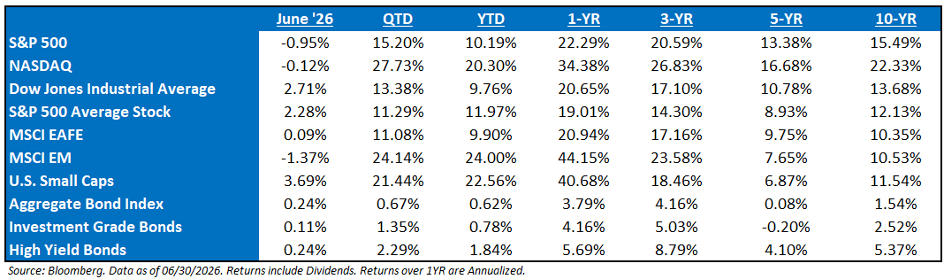
The first half of 2026 delivered another strong showing for global equities, though the path there was anything but smooth. Unlike the first half of 2025, which was dominated by tariff-driven volatility, this year's turbulence centered on the Iran conflict and its impact on energy prices. Markets found their footing by late March and staged an impressive recovery, rallying more than 16% off the lows through June as strong corporate earnings and resilient economic data overwhelmed the negative headlines.
Equities
The markets in 2026 have delivered strong performance across global equities. Despite a challenging geopolitical environment and apprehension about the path of global economic growth, many companies are doing well. Revenues are rising in aggregate, profitability is improving, and buybacks are soaring. Stock prices reflect those trends.
A notable and healthy development this year has been the broadening of market leadership. Rather than being driven by the mega-cap technology names that dominated recent years, gains have increasingly come from the companies supplying the AI buildout itself. For example, semiconductor and memory companies are benefiting from surging demand for AI infrastructure. Semiconductor strength illustrates how AI beneficiaries are shifting, but market gains haven’t been limited to just chips and memory.
The equal-weighted S&P 500 outperformed the traditional market cap-weighted index in the first half [i], a reminder that strength is spreading beyond the Magnificent 7 (Amazon, Alphabet, Microsoft, Apple, Tesla, Nvidia, Meta.[ii]) Mid- and small-cap stocks have outperformed the S&P 500 not only year to date, but since the post Liberation Day rally that began in April of 2025 [iii]. Banks are generating better profit margins due to higher interest rates. Healthcare companies are seeing rapid sales growth from innovative drug developments. Stocks in Europe, Asia, and emerging markets are gaining ground as governments increase spending on defense and infrastructure. A softer U.S. dollar and continued AI-related capital spending have also benefited these regions.
This type of broadening has historically been a sign of a healthy, sustainable bull market. Instead of depending on continued multiple expansion among a few companies, broader participation typically reflects improving profitability across a larger share of the economy.
Historically, bull markets have lasted longer than many expect. Since World War II, the average bull market has lasted more than five years. While the current bull market has risen approximately 120% since October of 2022, historical context is important. The average bull market gains roughly 191%, suggesting this cycle may still be younger than it appears. [iv]
Bonds
Unlike 2025's standout performance, this year’s bond market had a considerably rockier first half. Though the Bloomberg U.S. Aggregate Bond Index was flat to modestly positive through June, rising yields, driven by the same energy-price shock that rattled equities, have offset declines in bond prices. The 10-year Treasury yield broke above 4.5% and the 30-year above 5% in the spring, a stark reversal from the two rate cuts markets had expected coming into the year. [v] The silver lining: with yields now meaningfully higher, the income cushion available to bond investors going forward is more attractive than it has been in years.
Key Takeaways
The first half of 2026 reinforced several lessons that echo what we saw play out in 2025:
Diversification matters: Exposure across regions, sectors, company sizes and asset classes is important. The strong returns of international markets and small-cap stocks are great reminders of why diversified portfolios help manage risk and capture opportunities.
Patience through volatility: Despite headline risk, geopolitical tensions, energy concerns, sticky inflation, elections, and other uncertainties, equity and fixed-income markets produced positive returns. Attempting to time every macroeconomic development risk missing significant rebounds. A disciplined, long-term approach turned a volatile start to the year into a positive one for balanced portfolios.
Investing in structural themes pays off: Staying invested in growth drivers, such as artificial intelligence and productivity-enhancing trends, proved rewarding.
outlook
As we turn to the back half of the year, the same tension we discussed in January remains true today: there is almost always a case to be made for both optimism and caution, and 2026 has been no exception. The Federal Reserve's posture has shifted more hawkish (higher interest rate environment) than expected, geopolitical risk has already made its presence felt, and the midterm elections in November sit squarely in the second half of the year. At the same time, earnings growth has been exceptional, the AI investment cycle continues to broaden and deepen, and fiscal stimulus is still working its way through the economy. We revisit our opportunities and risks below with the benefit of six more months of data.
opportunities
Strong earnings growth continues to trend higher
Profit growth remains strong supported by productivity gains and operating leverage
Broadening of the market leadership in which companies in different sectors and regions are producing strong performance and earnings growth
Higher bond yields providing a more attractive income cushion for fixed-income investors than at the start of the year
Continued Fiscal stimulus momentum through tax cuts, targeted incentives, and reshoring initiatives
Increased private-sector investment, now extending beyond “hyperscalers”[vi] into semiconductors, memory, and infrastructure suppliers
Potential growth in sectors like energy, technology and financials driven by deregulation
Potential risks
Heightened geopolitical risks and their pass-through effect on energy and inflation
Elevated volatility around the mid-year election cycle
A potential break in enthusiasm for artificial intelligence and renewed bubble concerns
A policy misstep by the Federal Reserve: either raising rates too quickly or cutting rates too much
Persistent inflation running above the Fed’s target and complicated by both tariffs and energy prices
Signs of meaningful weakness in the labor market and a slowdown in consumer spending
Deeper Dive
The Federal Reserve entered 2026 expected to cut rates once or twice as the new chair settled in. Instead, Kevin Warsh was sworn in as Chairman of the Federal Reserve in May and has overseen a Fed that has held rates steady at every meeting this year, in a range of 3.50%-3.75%. More notably, the Fed's own projections and market pricing have shifted from anticipating cuts to now assigning meaningful odds to a hike before year-end, aided by the spike in energy prices from the Iran conflict and the lingering effects of tariffs. Chair Warsh has emphasized a return to "price stability." He has notably pulled back on the forward guidance markets had grown accustomed to under his predecessor, preferring to let incoming data speak for itself. [vii] This is a meaningfully different posture than we anticipated at the start of the year, and it is worth watching closely in the second half. That said, the labor market has remained resilient. Unemployment has held in a narrow 4.3%-4.5% band, and payroll growth has been steadier than expected, which gives the Fed room to stay patient rather than needing to act aggressively in either direction.
The Iran conflict served as this year's version of last year's tariff shock: a sharp, headline-driven test of investor conviction. Energy-market disruptions, including concerns over the Strait of Hormuz, pushed oil prices to their highest levels since 2022 and rattled both stock and bond markets in the first quarter. What's notable, and consistent with our view coming into the year, is what didn't happen: long-run inflation expectations stayed anchored, credit markets remained orderly, and equity markets recovered fully within a few months as tensions eased and earnings season delivered strong results. This is a useful reminder that geopolitical shocks, however jarring in the moment, are often absorbed by markets more quickly than headlines would suggest.
Mid-term elections remain a second-half consideration, just as we noted at the start of the year. Historically, the S&P 500 has experienced its largest intra-year drawdowns during mid-term years, and this year has already delivered on that pattern with the first-quarter selloff. The encouraging historical footnote still holds: the twelve months following every mid-term election since 1942 have produced positive returns for the S&P 500. [viii] We'd remind investors that markets ultimately respond to earnings and growth, not to which party holds a given seat. This perspective is especially useful heading into an active political season.
The debate over an AI bubble has continued throughout the first half, and if anything, the data has strengthened the case that this cycle differs from prior speculative episodes. S&P 500 earnings per share grew close to 28% in the first quarter on double-digit revenue growth, an unusual combination of top-line strength and margin expansion this late in an economic cycle [ix]. Importantly, leadership within the AI trade has broadened. Where performance was once concentrated in a handful of the largest cloud and technology companies (often called “hyperscalers” for the massive scale of their data centers), this year's biggest contributors have shifted toward the semiconductor and memory companies that supply the AI buildout, several of which have posted triple-digit gains in 2026 as demand for high-end memory has outpaced supply. We continue to believe the more productive response to AI-related valuation concerns is not avoidance, but disciplined, diversified exposure that captures the theme's broadening benefits while managing concentration risk.
Fiscal stimulus continues to work through the economy largely as expected. The tax provisions within the “One, Big, Beautiful Bill Act” (OBBBA), including the expanded SALT deduction, increased child tax credit, and higher standard deduction, have supported consumer spending and household disposable income through the first half of the year. Combined with resilient private-sector investment, this has helped offset some of the drag from higher energy prices and elevated interest rates.
Bond markets had a bumpier first half than most expected, a direct result of the same inflation and rate dynamics discussed above. The silver lining is that yields are now meaningfully higher than they were at the start of the year, which improves the return outlook for fixed income going forward even if price appreciation remains elusive in a higher-for-longer rate environment. We would also note that the AI-related buildout has begun to show up in bond markets directly, with “hyperscalers” issuing substantial new debt to fund data center expansion, a trend worth monitoring, as it could put modest upward pressure on corporate bond spreads over time.
Conclusion
The lessons so far this year reinforce that successful investing is driven by discipline, diversification, and a long-term focus. Earnings, not sentiment, remain the primary driver of markets, and there has been little evidence so far of broad-based deterioration that typically ends a cycle.
Looking to the rest of 2026, investors face both risks and opportunities. Geopolitical tensions, elevated inflation, the possibility of a Fed rate hike rather than a cut, and election-related volatility may continue to test investor patience. At the same time, strong earnings growth, a broadening AI investment cycle, and continued fiscal support provide meaningful tailwinds. Remember, caution is warranted, but history favors investors who remain diversified, optimistic, and focused on fundamentals rather than trying to time the market. [x]
At Sunburst, we remain focused on helping you navigate these times with confidence and clarity. As always, we are committed to staying proactive, informed, and aligned with your long-term goals.
It’s not about timing the market—it’s about time in the market.
We hope you find this outlook useful, and we look forward to continuing the journey with you. As always, we welcome your questions and conversations.